Thursday, 24 February 2022

Anna the Scammer - Netflix Inventing Anna, Random Thoughts from Episode 1

 The show is based on the article by Jessica Pressler, so it makes sense that the opening scene shows her article being printed, with a voiceover from Anna Delvey insulting us. We're about 30 seconds in, and there's already a lot to unpack. Firstly, Jessica Pressler has been renamed Vivian Kent, as if she is a fictional character. I'm fine with that, especially since the show doesn't claim to be a documentary or 100% accurate, but why do this for Pressler and not for Rachel Williams? Rachel Williams was not involved in the project, and the actress playing her has said she intentionally did not learn much about Williams because she wasn't attempting to portray the real her. So why use her real name? If it's in the interests of accuracy, and using information in the public sphere and so on, why change Pressler's name? Pick a lane. I'm mad about this, because this show has turned Rachel Williams into a target, which she doesn't deserve.


Opening with Delvey insulting us, the viewers, is a solid start to her characterisation throughout the rest of the show.


The printed newspaper fades into social media, showing comments and likes and whatnot. Unlike Delvey being insulting, this isn't really followed up as a theme. In some ways it is, with Vivian Kent using Instagram to track Delvey down, and part of Delvey's motivation apparently being how she looks in Instagram photos, but, from this opening, I'd have expected Instagram to play a role in either her original motivation to start scamming people, or to help her track people down and trick them, or even as part of her scam, to convince people she's richer and more well-known than she is. That just isn't followed up on. Personally, I don't think Delvey needed modern technology, especially since a lot of her scams relied on it being unavailable, like claiming there were problems getting money from her trust fund into the US. She did a lot of the old-fashioned stuff, like paper-hanging and forging wire transfer confirmations. The show portrays her as fundamentally millennial, but personally, I think she'd have conducted the exact same scams in the 1920s, and probably would have had an easier time doing so in some ways. 


Delvey's voiceover continues, encouraging us to be like her. The show claims it isn't actually trying to encourage people to be like Delvey, and it's possible they intended this voiceover to be so insulting that everyone immediately decides they don't want to be like her. If so, I don't think that message is clear, especially with the sympathetic points made in Delvey's defence later on.


We segue into Delvey's arrest and the reactions of various characters, some based on real people and some more inspired by the types of people Delvey scammed. One of those based on a real person, Kacy Duke, says that Delvey's arrest is "karma" and "the universe corrects all wrongs." Later, we see her shouting at Rachel Williams, insisting that it's morally wrong for Williams to have been involved in Delvey's arrest. This seems hypocritical. She agrees that Delvey should be in prison for scamming them (and others), but she also thinks it's a betrayal for Williams to have played a  role in that? Again, pick a lane. Delvey made it very clear that she was not Williams' friends when she put her in a dangerous situation and forced her to spend money she didn't have and risk her career to get out of it, so Williams' clearly wasn't betraying a friend when she helped get her arrested. On the other hand, if Duke thinks Delvey was actually their friend, how does she justify the scamming?


I need to be very clear here that these are the viewpoints of fictional characters, despite those characters sharing names with real people. The real Kacy and Rachel were not close friends and didn't hang out together as portrayed in the show, so they wouldn't have been having this conversation, and I have no idea if Kacy Duke held any of the opinions she's given in the show. Personally, I suspect the show is just using the character as a convenient mouthpiece.


Two of Delvey's other victims insist that the article only appeared in a small paper and that no one will pick it up. This is the very first piece of information we get about the paper the article is printed in, so the obvious interpretation is to take it at face value. I think the more likely interpretation is that they're engaging in wishful thinking, but that's not clear at this point. I'm not clear if they're talking about Kent's article, which is the one we were just shown, or the article which inspired Kent. The very next scene is actually about Kent proposing her article, which is not written until the last third of the show. I can't tell if these scenes follow the first or second article.


Kent gets to work, and the staffers are talking about Trump and Obama in a way that makes it clear Trump has just been elected. Kent has read an article on Delvey - which is not the article we saw being printed earlier, that's the much later article that Kent ends up writing - and wants to write about her because no one knows anything about her, whether she's rich or flat broke or where she came from. Her editor doesn't want her to write the story.


Cut to Delvey's lawyer, arguing that she should be allowed out on bail because she's not a dangerous criminal. I think he's ignoring the fact that she's talked her way into and out of all sorts of places and "borrowed" jets and yachts before now. We, the viewer, don't know that yet, but he does. The lawyer, Todd Spodek, is also based one-to-one on a real person. He hasn't faced the backlash Williams' has, as far as I know, and I don't know if he signed off on the portrayal of him. I think it shows him as good at his job and generally in a positive light, so I feel morally okay with that, even though it's still weird to keep his name the same but change Pressler's.


Overall, I like the lawyer character. He's entirely on Delvey's side, spinning a story to make her sympathetic, but that's literally his job. The US and UK legal system (and others) both share the idea that someone HAS to be on your side, just in case it really is just a coincidence that you look so guilty. Someone HAS to believe in you and your innocence, by law. That's Todd Spodek's job, and he's doing it well.


In contrast, a journalist's job is to find the truth, and I don't think Kent does as good a job of that. Based on this series, I don't think Pressler did either, because the series refuses to state a conclusion about Delvey and seems enchanted by all the possibilities she spun as part of her con. The one thing the show does make very clear is that Delvey is very, very good at convincing people to see her how she wants them to see her, and it seems like they've managed to fall for that while creating this show.


Kent's gone to the trial to find information, and accosts Spodek as he leaves court. He doesn't want to give her any information.


At home Kent argues with her partner about her career vs her pregnancy, which I keep forgetting about. This debate is a running thing for Kent, throughout the series, but it still feels tacked on, like if Pressler hadn't been pregnant in reality during these events, they would have dropped it or considered a different personal challenge for her. I've been trying to figure out why, and I think it's related to the fact that the whole thing feels like it lacks a theme. Like, normally you can sum up the message of a story in a sentence, like Midsommar is "don't give into damaging urges during a break-up because they are bad for you and everyone even if they feel good,", or Encanto is "you matter because you exist, not because of what you can do." But this series defies that kind of summary. I can't summarise its theme. Normally, subplots, like Kent's pregnancy would tell you something about the theme, and it can't if there isn't one. Alternatively, the subplot turns out to impact on the real plot, but this one doesn't, really. If they're given the show a theme about the choices different women make, then it would have fit. That would have been better. They could have enhanced parallels between all the different women, and what they do to escape their circumstances and the different choices they have to make.


Kent decides to write directly to Delvey, who responds, inviting her to the prison. Meanwhile, Spodek meets with the prosecutor. He tries to convince her not to try the case, but she disagrees because Delvey is literally a criminal. I like this interaction. They're both doing their jobs. His job is to be entirely on Delvey's side, and believe she is innocent. The prosecuter's job is to be on the other side, and believe Delvey is guilty. Theoretically, their biases cancel out to reveal the truth. I like that the show doesn't really portray either of them as evil or wrong or unreasonable. At worst, Spodek is inclined to believe Delvey is innocent if there is absolutely any space to believe she might be, which, again, is literally his job. I also like that Spodek brought his kid - it's a clever way to get them not to swear onscreen when the characters otherwise naturally would, and it characterises Spodek.


They present their viewpoints - that Delvey is everything wrong with America vs Delvey is Robin Hood. Personally, I am on the prosecutor's side. Delvey took money from the rich, but she wasn't trying to give it to the poor. She wanted luxury, for herself. She wasn't trying to break the system, like Robin Hood, she wanted to be a part of the system. Her entire goal, according to her and the show, was to create the Anna Delvey Foundation, an exclusive club for the rich. She wasn't Robin Hood, protesting unfair taxes by taking them away from the rich and giving them back to the poor. She was fully in favour of the rich and how they got their money, she just wanted some of it in her own hands. Arguably, some of the money did make its way to the poor, via the $100 tips she was famous for leaving, but that was part of Delvey experiencing a luxurious lifestyle. They weren't gifts, they were about Delvey feeling wealthy.


Kent meets Delvey in prison. I do like how these scenes are written and performed. Kent is clearly underestimating Delvey and patronising her, while Delvey always manages to wrongfoot Kent and leave her trying to defend herself.  One thing that seems odd is Delvey manipulating Kent by appearing vulnerable, which isn't something she really does at any other point. If this is one of her tactics, why not use it more elsewhere? Or, perhaps, she is genuinely feeling vulnerable but she keeps her eyes on the prize regardless.


I feel like Delvey's strong accent might have helped her get away with a lot. I had a friend at university who had a very strong German accent, who was also horrendously rude. Even though her English was excellent, like Delvey's, when she said something rude to you, one of the excuses you'd make for her was "it probably sounds different in Germany, she doesn't mean it like it sounds."


Kent's back in 'Scriberia', where old writers go to die, being mentored by the old writers. I don't know if they're real. I think they're here so can Kent can talk about what she's thinking and planning and have someone to bounce off throughout the show. The first plan is to call people, but no one will talk to her.


We cut to Spodek telling his wife he's received a plea deal for Delvey. We get his backstory, about basically not being a big deal as a lawyer. The ending tells us this case made his career and now he's the go-to lawyer for this kind of fraud. I'm not sure if this is real or just a story arc for the character.


...I googled and I can't find a lot about Spodek's career prior to the Delvey case. I'm sure it's there, it's just being buried by stuff about the show. I quite like the actor and that his preparation process involved reading the court transcript so he knew what actually happened. I think that might be part of why the portrayal is pretty good. In contrast, the actress playing Rachel Williams said Rachel became real for her when they got to Morocco, as if she's not literally a real person. That's not necessarily a fault of the actress, but it does imply that the "Rachel Williams" of the show is a lot more fictitious than the "Todd Spodek." That could easily be due to the writers, producers, and director, not due to acting choices.


Kent is being called upon to justify why she's working on this story, despite being told to write a #MeToo article instead. Her argument is, that story is over, they'll just be pestering these poor women for attention and clickbait, when said women just want to get on with their jobs/lives. I personally don't see why she can't work on both, or why she acts as if the only way to write a #MeToo article is to pester women who don't want to talk. I'm pretty sure there are other ways. Again, no idea if this is based on reality or just for the purposes of storytelling. Again, if they'd chosen to lean on a theme about the choices women make, this is where they could have tied that in. Some women choose to speak up about their stories, some women stay silent, some women follow the rules to get ahead, some risk breaking them and either succeed or fail, etc. I think they might be trying to link Delvey and Kent as uppity women who go against what men want, but, tbh, I think Delvey ended up scamming a lot of men because men were in charge at the banks, not because she was trying to oppose the patriarchy.  It's like how some of the money she stole did end up going to the poor - it was an accident and not enough to actually make a difference, so it's ridiculous to claim it as a feminist or classist point. Not that the show is - I'm really not sure what point they're making, or even if they're making one.


We learn a bit about Kent having some kind of history, which is Paul's fault. It turns out she wrote an article about a kid who got rich playing the stock market, who turned out to be lying about the whole thing. I think they try to link that to her interest in Anna, like that's why she's so fascinated with con artists, but it's a pretty weak link that's not stressed very well.


Kent goes to one of the hotels Delvey scammed, sees the $1700 a night room she stayed in with no credit card on file and no way of paying, and meets Neff, another character based on a real person. Neff remembers Delvey fondly, which makes sense because she wasn't actually scammed by Delvey. She did believe Delvey was an heiress, but that didn't cost her anything except a temporary loan for dinner which was actually paid back. Neff also made a profit from Delvey's $100 tips. If she did feel betrayed by being lied to by someone she thought of as a friend, that would make sense, but it also makes sense that she doesn't.


Kent does a montage of interviews and hears the different things people believed about Delvey and where her money came from, and a few contradictory stories that aren't that intriguing.  One person made out with her, another claimed she had no interest in sex, one claimed she had loads of clothes, another claimed she wore the same black dress constantly. That's just different people knowing her at different times. In this montage, my favourite character is Chris Caffero's David Morrison, who is blatantly just loving the chaos and drama. I don't think he's based on real person. He tries to assault Delvey at one point, so you'd think there'd be more outcry if he were.


Now we get to see Kent's murder wall. You know, photos linked by strings and things. She's shocked that Delvey has different hair and clothes in different photos. It's super lame. Plenty of legitimate Instagramers have a range of styles like that, it doesn't mean anything. The show doesn't even claim Instagram played a role in her scams, like Delvey didn't even use it to trick people into thinking she was friends with anyone or to stalk people, so who cares? Kent does use it to find all those people she interviewed, and apparently this murder wall thing is just a way to visualise Pressler's google docs and spreadsheets. It's so lame. Also, having a physical murder wall means the show can put it in Kent's child's nursery, so they can be like "ooh, motherhood vs career!" and it's so fucking lame. It could have been a thing, but no one cares about Kent's maybe (I'm sure people do care about Pressler's baby, I'm just complaining about this fictitious child). I swear, if Pressler hadn't actually been pregnant, they would have picked a totally different issue for her private life. 


Kent uses her stupid murder wall to pose proudly and ask "who is Anna Delvey?" which would make sense if Delvey's scams had involved multiple disguises or alias, but they didn't, so who cares. Not a question, no one does.


Kent visits Delvey in prison and carries on her patronising her. She ignores what Delvey is saying, assuming she already knows, and acts like Delvey is obligated to answer her, despite Delvey clearly not having agreed to an interview yet. We know she hasn't, they make a big deal about it, so it makes Kent looks like an idiot for forgetting. Delvey makes her feel small and defensive again. Delvey threatens to accept the plea, knowing that means Kent loses her chance to write an article. The older writers explain that to her - she won't be able to drive to see Delvey in one of the far away prisoners she might be sent to with a new-born. Kent has a gynaecology appointment and cries about work vs motherhood. It's all really boring.


The only reason Kent is such a big character in this show is because they actually know very little about Delvey. They don't know everything she did, or why, and they're not willing to make a statement. That means they have to focus on someone investigating her, who never actually completes their investigation and comes to a conclusion about who Delvey is, and that's why they've had to pad it with all these pointless subplots no one cares about.


You know, they could have done a thing about Delvey being a mystery, like new-borns are a mystery, and you never know who someone is going to grow up to be. That would be something, a way to tie the subplot to the main plot.


We're back to the murder wall. The murder wall should have been about constructing a timeline or something. Anyway, Kent sees Neff in a photo and realises she was quite close to Delvey, so she goes to interview her. Neff refuses because she considers Delvey a friend. Kent claims that Neff, Rachel, and Kacy were clearly all good friends with Delvey, which is totally fictitious. Neff has worked out that Kent doesn't get a story if Delvey takes the plea - how? It's really not obvious - and that Kent wants to persuade Neff not to take the fee. Neff claims that everyone in New York is running a scam, which explains why she can still see Delvey as a friend. 


Kent has linked the interview to her self-esteem/career/justice, which are strong motives but they don't really work here. I don't know why. Maybe because the birth of her child is such an arbitrary deadline, since loads of women have careers alongside motherhood. It matters to her, but it's really not that big a deal. She could just get over it, so it sounds like a pathetic motivation to us. Or maybe it's because it feels like Kent hasn't been doing the work, she's literally just had this fall into her lap and has randomly decided to make it her life's work. Also, it seems pretty lame that she'd spend 6 months on one article and have no time for any other articles work, that cannot be how journalism at the New Yorker the Manhattan works.


Okay, I looked, and Pressler was generally writing 3-4 articles per year for The Cut, so maybe it does work. I still doubt that was all she wrote. I think she could easily investigate this without refusing to do any other work. She's just put her career at risk for no reason, so it doesn't feel like a real motive. All of the things she's risking, all of the problems she has, are really, really easy to solve and the show doesn't give us a good explanation for why she doesn't just get over herself.


Anyway, Kent uses all of this - her own need - to try to persuade Neff to tell her what motivates Delvey and, despite all sense, it works. It's not a real need, she's literally just standing in her own way, and nothing about it addresses Neff's objections.


Kent has finally gotten a media visit sorted. What happened to all that fuss about how long it would take? Is the idea that she put it in motion, then went and interviewed Neff while she waited? Why couldn't she just write the #MeToo article in her downtime? Or are we supposed to think she put herself in the virtual queue for a media visit and then went and visited Delvey on a normal visit while she waited? If so, why would she not say that when Delvey brought it up? Also, why would she do that? Kent clearly through the normal visits were fine and it took ages for her to figure out that Delvey had a problem with it, despite Delvey outright telling her so.


Delvey tells Kent she's taking the deal and not doing an interview. If she doesn't take the deal, she risks 15 years in prison. It turns out that what Delvey wants is fame, or at least Kent saying that is what persuades her. The show doesn't seem to stick with that as her motivation though, which is probably why it feels unfocussed and like the question of "who is Anna Delvey" is never actually answered. It doesn't ever seem like she's motivated by fame. She's not trying to be famous on social media, even though she uses it. For most of the show, Anna just seems to be motivated by pure lust for money and luxury.  That's allowed, though what she did to get it isn't. The show doesn't need to make excuses or pretend she's anything but materialistic. Some people are. It's not a character flaw in itself (though it's often presented as one). Delvey could just want nice things and feel entitled to them. I think sticking with that might be a stronger explanation for why she's like this. 


We're finally at the end of the episode.


One thing that bothered me on my first watch of this show is the way it feels like it reaches a climax and ends, but then drags on for another 2-3 episodes. I've been trying to figure out why I felt that way, what signalled to me that the show was 'supposed' to end. I think it's because they open the first scene with the article being printed, so it feels like the story should end with the article being printed. Sure, Delvey tells her that the story is about her and not Kent, but that doesn't tell us it's not about the article being written. Plus, I don't think Delvey ever directly addresses us again, so it's a lie to call it her story. If it were her story, she'd be able to tell us who she is and the show can't and doesn't. 

Wednesday, 23 February 2022

TV Shows Don't Have to Have an Opinion on Social Media; Clickbait, Chloe

 I've decided to start using this blog again, because I have some thoughts on films (and TV shows) that I want to share. That's also why I've renamed the blog. I think most of my posts are going to be random disjointed thoughts or ideas rather than outright reviews, though I probably will throw in some of those as well.


Both Chloe and Clickbait are limited series', which I love. That's a series which tells one story then ends, rather than being a longer running thing that needs to keep coming up with new ideas. Honestly, I think a lot of stories are just much stronger being told that way. For a counter example, look at How I Met Your Mother. They locked into a specific ending early on and refused to deviate, even as the show itself grew and changed. In a limited series, that would be fine. You retain tight control over the plot, you can build towards that ending. In a long-running series, though, you need to keep coming up with new episodes and plot points and character arcs, which meant HIMYM ended up somewhere very different to where it actually needed to be for their ending to work. A really nice in-between option is anthology series', like Cruel Summer, and The Haunting of Hill House/Bly Manor, where you tell different stories each season, so you get the benefits of telling one single story from start to end and also the benefits of making multiple seasons with the same team and really getting into a solid groove.


The other thing Clickbait and Chloe have in common is that they are both thrillers in which social media plays a key role. That leads me to my first rant, about the idea that TV shows should have an opinion on social media. I've seen this idea in reviews for Clickbait and Chloe. Why do these shows need to come down on the side of "social media is good!" or "social media is bad!"? It feels like we've reached the point where social media is a fact of life, like kitchen knives. Dramas which involve someone being stabbed aren't criticised for not making a clear statement about whether knives are ultimately bad or not.


Both shows introduced a key character whose motives are unclear, which is common in thrillers. What Chloe did, which was very interesting, was to make that character the main character, and have her motivation not be the obvious mystery of the show.


Spoilers for Chloe Below.


The main character is Becky, and our first impression of her is that she's a con artist/stalker. The show makes it seem like she's obsessed with a random woman, Chloe, (via Instragram) and that she takes the opportunity to lie her way into Chloe's friend group after she dies. We see Becky calmly lying about her identity and manipulating people, and we even have a few hints that she knows more about Chloe than she let on. It feels like the book The Perfect Girlfriend, where we follow the villain rather than the hero. But then, as the series go on, we learn that Becky was actually Chloe's childhood friend, which is why Chloe called her before she died. Becky's trying to find out how Chloe died, partly from loyalty to her friend, partly from fascination with her world and her desire to be invited in.


In reviews and on TV tropes, I've seen people discuss "what's wrong" with Becky. Is she a psychopath, a sociopath, what? My take is she's neither. Fundamentally, I think she is Sasha, she's a woman who can fit into this world, who can be calm and confident. She could have legitimately had the career she claimed to have and to be friends with these people (if they weren't all terrible). She didn't because of her self-esteem issues, because her mother is abusive and has spent her whole life tearing her down, and because her best friend rejected her for no apparent reason in their teens. She doesn't believe she can be Sasha because she's Becky, and Becky is worthless. It's only when she tells herself that she's lying, that she gives herself another name, that she can blossom, that she lets herself be the woman she could have been. I think the only reason people assume she must be a sociopath or a psychopath is because the series' introduces her as the villain and people get stuck on that idea even as they learn more about her.


Spoilers for Clickbait Below.


This doesn't have anything to do with Chloe, I've abandoned comparing them now. This is just a thing I wanted to talk about.


For me, the weakest plot point in Clickbait is how the characters got so hung up on whether the mistress had actually met the husband or not. Even if she hadn't, that didn't prove that he wasn't having an affair with the other girl. Conversely, even if she had, that didn't prove he did have an affair with the other girl. It was really illogical and annoying how stuck on this the characters got. It just didn't make sense. Sure, if he never met the fiancĂ©, that's a tiny bit of evidence that maybe he never met the other girl, but why not just focus on finding out whether he ever met the other girl in the first place? Go straight after the thing you wanted to prove, rather than something that can't give you that answer.


It might have been more interesting if he genuinely had an affair with the mistress and then his weird stalker was inspired by that to fake an affair with the other girl.


Saturday, 2 April 2016

Bitching About Pitching: A Scene by Scene Review of Why Pitch Perfect 2 is Aca-Awful

The movie opens with a quick rundown of how well the Bellas have been doing, during a performance in which Chloe briefly pretends to be a dolphin.  So, if we're going to create the exact same movie as last time - which is surely the goal - they need to become underdogs!


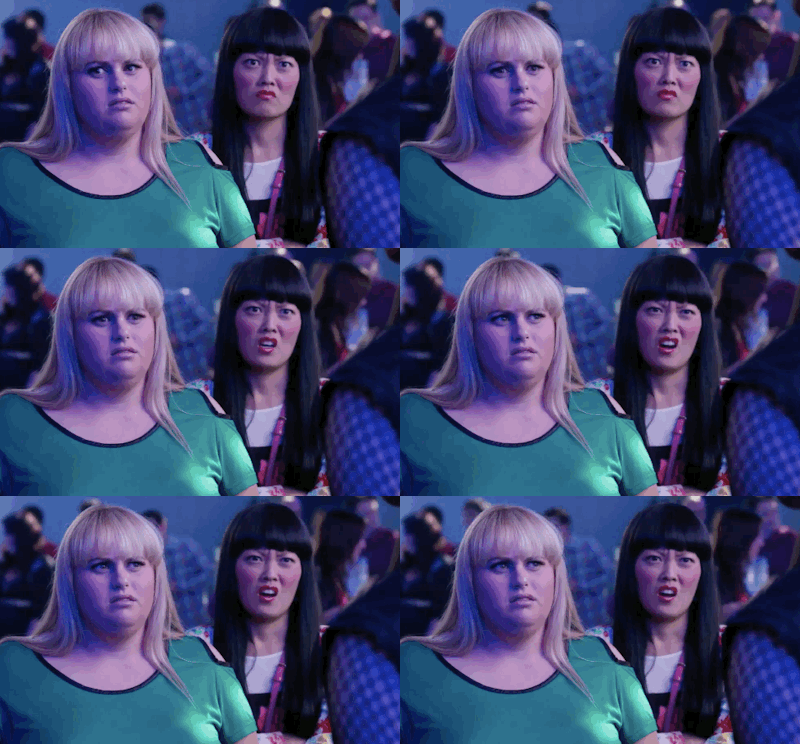
Beca is the new leader of the group.   And there's a new girl - a woman of colour!  Perhap she'll be an interesting, fully-rounded character.  Oh no, she's a wacky, slightly racist, stereotype (as in, her portrayal is racist, not that the character is racist).


This happens when Fat Amy's trousers split while she's hanging in mid air.  All discussion is of how disgusting fat women's genitals are, and how heinous and disgusting the Bellas are for exposing people to this.  No discussion of how Fat Amy feels about this though we do see her apologise publicly.  No believes the incident was purposeful as a publicity stunt; everyone knows it's an accident yet they still feel Fat Amy and the Bellas deserve to be punished for exposing the world to a fat woman's genitalia. They're called tramps, and banned from performing or holding auditions.


Another new girl appears; a freshman just starting college, with a clingy, ex-Bella mother.  We learn she writes songs.  Gosh, a new girl with a musical hobby, where have we seen that before?

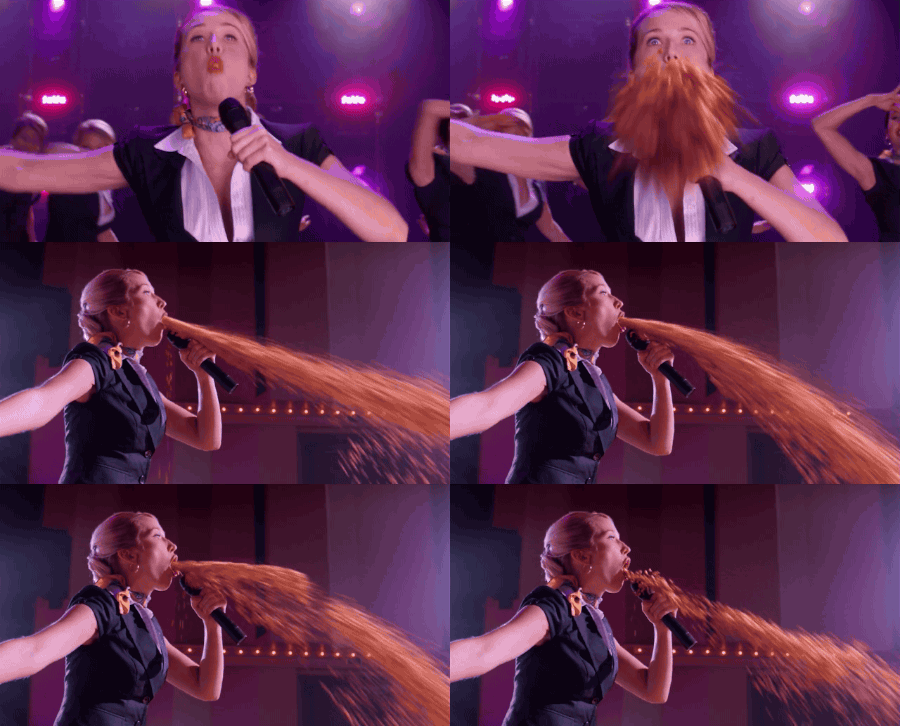
The Bellas realise they've not been prevented from performing at the World Acapella Competition.  So it's kind of like how, in the last movie, they were on top before the embarrassing vomiting incident and needed to regain their composure and singing ability.  Only this time, no one's left and no one has stage fright so bad they throw up.  They're still working at championship level, they just need to change the choreography for one specific song.  No one seems to realise this; the governing committee laughs at the idea that they might win and agree to reinstate them if they do.

We get our first and only performance from the Treblemakers.  It's quite a slut-shaming song, which I'd let pass if the rest of the film wasn't so godawfully crap.

The Bellas are all freaking out about this huge challenge, huger than any they've ever faced.  They must focus and train!  That's totally not what happened in the first movie.  Beca is less interested; she's starting an internship as a producer.  Totally dissimilar to the first movie.  Oh wait.

Jesse, Beca's boyfriend, meets the new girl, who confesses to her one and only dream of being a Bella.  Kind of like how much Benji wanted to join the Treblemakers.  Benji's here too; he hits on the new girl.

The Bella's are now sharing a house, like a little sorority; a sorapella, if you will.  They find that their biggest opponents are a German group, who took over the tour they weren't allowed to play.

Beca's actually starting her internship now, and feeling guilty about not being 100% Bella, especially after Chloe has purposefully flunked three years in a row so she doesn't have to graduate.  Beca's immediately pulled into a meeting with her new boss, who is so depressed at the incompetence around him.  I'm sure Beca won't magically do something to impress him and restore his faith in his staff.  He announces that they're making a Christmas album with Snoop Dogg.  Is he still doing stuff?

Bossguy needs a new and unique idea for Snoop Dogg's album, so it's not like every other Christmas album in the world.  Bossguy is actually the best character; most reasonable and original in the whole movie, you'll see.  Beca is too nervous to offer up her mixing skills, which no one else has ever thought of before, despite an explicit invitation to do so.

New girl has sought out the Bella's, since they weren't at the auditions she attended.  Fat Amy says they're not allowed to take anyone new, which I don't think is actually the case.  They were told not to hold auditions, not to avoid taking someone new if they show up on the doorway with terrible eyebrows and beg.

New girl is Emily Junk.  Very fitting.  Her mother was the 'top bitch' of a previous generation of Bella's.  Chloe decides that if a legacy wants to audition they have to let her, and I'm positive that isn't in their suspension rules either.  If they can just make this shit up as they go along then why are they pretending it's such a big deal?

Junk would like to perform an original song, after telling Fat Amy she has a lovely vagina.  The song is completely shit, but everyone pretends it's amazing.  Contrast this film to Music & Lyrics; if people are going to pretend a song is a hit it has to be a good song.  Here's Pop! Goes My Heart. 


The movie hinged on us believing that song was a hit, and we do.  This movie hinges on us believing that fat women are disgusting, racist stereotypes are funny, and that Junk's flashlight song - with the same tune as Titanium - is better than something a six-year-old could write.  We don't.  I'm not embedding it; the bits that are original are shit and the bits that aren't shit aren't original.  It's not even a stylistic suck; everyone in the movie acts like it's amazing.


Chloe finally realises that the rules prohibit auditions, not accepting new members.  Fat Amy repeatedly points out the silliness of the TV convention of pretending that a person in the same room can't hear you if they're not in shot.  Nice try.

They vote by singing specific notes and head out to a party with their new Bella.  It's an Acapella only party.  That certainly didn't happen in the last movie.

We learn that Beca is neither with Jesse nor the Bellas, and Benji awkwardly flirts with Junk.  He is not put off by her terrible eyebrows or poor songwriting skills.  In fairness he hasn't seen the latter yet.

Bumper shows up as a new campus security member.  Fat Amy awkwardly flirts with him.  She really can do better than a guy who constantly insults who, and who assaulted her with a sandwich in the last movie.


Bumper has entered American Idol or America's Got Talent or whatever.  Considering he was a backup singer for John Mayer you'd think he'd know how to attend a normal audition rather than relying on reality TV.

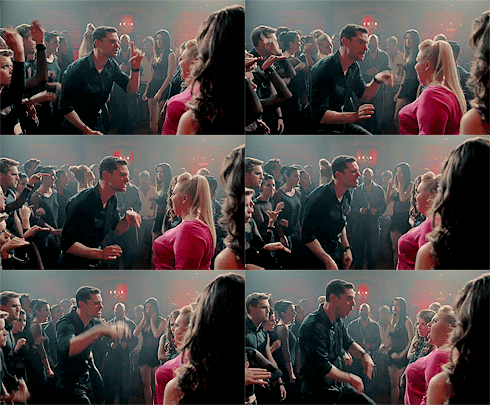
Now we get a random scene of everyone dancing to a song which isn't acapella.  This is not what I signed up for.

The Bellas go to watch their competitors perform.  They sing in German accents which is odd because in my experience, Germans sing in Cockney accents.


Das Sound Machine sing a song which showcases them as robotic and technically excellent.  I'm sure the Bellas will beat them down with creativity and heart, wrapped in a fucking awful song.

The Germans are mean and bitchy, which is disappointing.  They have no reason to hate the Bellas more than any other group.  It would have been interesting if they'd been interested in winning, but totally bemused at this hate-filled rivalry from the Bellas.  Rather than being, y'know, villians.  Have we not got over Germans as acceptable movie villians yet?

Beca is so attracted to the female lead of Das Sound Machine that whenever she tries to engage in an argument she ends up blurting out compliments instead of insults.  This is actually quite funny.  More of that, less scene-by-scene remakes of the first movie with crap original songs please.


Fat Amy steps up to trade insults with the male lead of Das Sound Machine.  They have much more chemistry than she does with Bumper, and he has yet to throw food at her.  She could still do better than someone who regularly insults her.


We go straight to the Bella's rehearsal, where Beca has stepped in to Aubrey's role as we prepare for a training montage.  Though when the training starts, Beca's on her computer while Chloe actually does the training.  Junk approaches Beca for advice, but she has somewhere she needs to be.  She needs to go liven up Snoop Dogg's rendition of Walking in a Winter Wonderland by singing Here Comes Santa Claus over it.  Genius.  She doesn't tell them what she's going to do, she just asks the producer to have Snoop sing it again exactly the same way.  Somehow, he goes for it, seemingly in a fit of despair.

Bossguy is impressed!  Beca did good!  Bossguy offers to listen to some of her work, since she has succeeded in adding value to a project.  He's a good bossguy.

Back at the Bella Soropella the other Bellas are having a slow-motion pillow fight.  They've been invited to sing at a midnight party.  I'm sure this won't be at all like a scene in the last movie.  I have hope.  They go to a strange guy's house; he takes them down to a basement where a sing-off is happening.  My mistake, it's a shot by shot remake of the sing-off in the last movie.  Bumper's joined the old guy's acapella group; Donald Faison wisely declined to reprise his role, so they've replaced him with another black guy and hoped we wouldn't notice.  They stuck lots of hair on to disguise him

Benji ruins the Treblemakers number through being distracted by Junk's eyebrows.  Junk tries to sing her original song as a 90s hip-hop jam because she's just so proud of having written a godawfully crap song, and is clearly a bit dim.  She's got a real Dunning-Kruger thing going on.  Creepy guy hates her and calls her embarassing and unprofessional.  Most reasonable moment in the film, apart from Bossguy.  Beca learns that Junk is a song-writer, and is impressed!


Bossguy is disappointed that Beca gave him more mash-ups.  He knows she can do mash-ups.  Lots of people can do mash-ups.  He wanted something original.

Beca goes home where she tries to do something original and Fat Amy reveals they all know about the internship and tries to cheer her up.  Then Fat Amy sneaks off to a date with Bumper, who proposes that they date.  At least he's being less of a dick now.  She turns him down anyway and they break up.

The Bellas are on their way to perform at an old folk's home, which is totally dissimilar to the performance they gave in the first movie where they were sent away without being paid.

Statler and Woldorf have another little chat about disgusting women's genitalia is before watching the Bellas perform, something they explicitly told them not to do at the start of the movie.  They sing Natalia Kills 'Problem', which was much better used in We're the Millers.  The Bellas are accused of "not knowing who they are any more" due to the use of props and fireworks, culminating in an accident where Cynthia Rose is set on fire.  Judging by their performances so far in this movie, that seems like exactly who they are.  Chloe decides they must go on a retreat to get their groove back.


Junk has a chat with her mother, expressing her disappointment over her Bellas career so far.  Well fuck you, who is else is going to listen to your shitty songs?  We get some foreshadowing for the ending.  Benjo and Junk have a horribly forced moment.

Aubrey's running the retreat, so this is really just a weekend away for her and Chloe.  Aubrey's upset that the Bellas have lost their harmony (again).  We get another reiteration of how big this world competition is for them.


There's quite a cute scene where the Bellas are forced to share a tent, with their heads all together in a row along the middle.  Chloe and Beca share a les-yay moment, Lily licks Beca's nose - in what is the single best moment of the movie - and Cynthia Rose fondles The Hunter.  They have a little singsong, not at all reminiscent of Party in the USA on the coach.


We're treated to a montage of the Bellas training and singing.  It's rather good; we get snatches of The Boogy Woogie Bugle Boy from Company B, and Mmmmbop, before Beca throws a hissy fit about them singing songs that would never go in their set, and how they have to get back to their roots.  Isn't that exactly what you broke them out of in the last movie, Beca, singing the same old songs over and over?


Aubrey calmly explains that this is just an exercise to try new things, and Beca doubles-down on her fit so they can all have a row about her producing internship.  Beca becomes defensive, despite the fact that not one person has criticised her for doing something as well as being a Bella.  Why would they?  They all have classes.  Chloe might be a bit obsessed but she's not totally unreasonable.  Beca claims no one else is focused on the future, which begs the question of how she would know?  It's not like she's been talking to anyone else.

Beca is forcefully prevented from leaving by the appearance of a net which scoops her into the air.  Good job Aubrey.


Beca is apparently in oh-so-deadly peril, despite being able to fall out of the trap quite safely, which she does a few minutes later.  Junk and Beca bond because Beca is "so good".  What is Junk basing this on?  Beca asks her to collaborate on something, and Junk is overjoyed. 


The Bellas all reveal that they have, in fact, been planning for the future and Beca is just too self-obsessed and arrogant to have noticed. Then they bond by singing Beca's cup song from the first movie, because this film isn't quite derivative enough.  This magically means they have found their sound.  Fat Amy also realises she's in love with Bumper, out of nowhere.  She goes off to serenade him, while he rejects her like the dick he was in the first movie.


It's the one music number in the movie which isn't ridiculously overproduced.  To illustrate the crapness of their relationship, perhaps?  Bumper has a sudden change of heart, for no apparent reason.

Beca and Junk are now producing Junk's shitty song.  We are forced to listen to the final product.  It is shitty.


Bossguy is impressed, which kind of makes sense if you ignore how utterly crap the song is.  Beca has gone away, found an original artist and produced something, which is what he was encouraging her to do.  It's the Music & Lyrics problem though; this entire plot hinges on the song being believably good, and it's not.


The Bellas graduate and head to Copenhagen for the contest; that was sudden.  We get a quick walking-in-Copenhagen shot and a hint that the Bellas are planning something new before we go back to Statler and Waldorf for racist jokes.  In the first movie, Statler was offensive and Waldorf offered a voice of reason; now they're both just offensive, which sends the message that the film's makers really believe this stuff.

Benji and Junk do more awkward flirting.  The other groups all sing the exact same song, because a medly of different songs or a mash-up would be totally out of the question for this movie.  We just get a single song montage, with a quick shot of DSM chanting in a way which is totally harmonious.  I think they deserve to win; they work a lot harder than the Bellas do, and the female lead - whose swear smells like cinnamon, according to Beca - speaks seven languages.  Completely understandable to sing in a strong accent then.


They give a very antagonistic performance, because apparently Germans are like that.  They also have the good sense to stay away from the fire during their performance.  And to use totally virtual fire.  They also end with miming raising the flag on Two Jima, which confuses the Evil German message somewhat.  What is the symbolism here?  What are they trying to say?  I am baffled.


Statler proclaims that if the Bellas of old show up, they have a decent chance to win.  That doesn't seem totally implausible, considering the only difference between the old Bellas and the new Bellas is two stage accidents and the addition of Junk.  Just tone down the choreograph and lose the loser.  Main conflict of the film solved. 

They start with a clapping game, which is essentially just a variation on the cups thing.  I will curse them.  They're singing Girls! (Run the World), which is probably the lamest, most unoriginal symbolism I've seen since the antagonists sang a song about dominating their competition, about three minutes ago.


We get a mash up of the songs we've already seen performed throughout the movie.  And then fucking flashlight.

I think the main reason Flashlight fails as a song is because the basic imagery doesn't work.  "My flashlight/getting me through the night".  Who sits up all night holding a flashlight?  Why would you do that?  Even if you're having an emotionally tense night why would a flashlight help?  Are you a child?  Because if you are a night-light is more typical.  They're going for a 'light in the darkness' theme, but you'd only really use a flashlight for that if you were being chased by wolves in the middle of a forest.  It completely fails as a metaphor.


Most songs also build upon three 'wham' lines, or small reveals, or three movements through time, etc.  The song goes somewhere.  This song doesn't build; we're given the information that the singer is scared of the dark, but someone else helps her cope with it, right at the beginning, and then nothing; just iterations on a theme.  Also, the lyrics are stupid; even with a decent build and metaphor, you still need to have a gift with words, or at least be able to express a coherent idea.  Look at this;

Kick start my heart when you shine it in my eyes
Can't lie, it's a sweet life
Stuck in the dark but you're my flashlight
You're getting me, getting me, through the night

Is he the flashlight, or is he holding the flashlight and shining it in her eyes?  How does that help with her fear of the dark?  Why on earth is being stuck in the dark 'a sweet life'?  And, again, who uses a flashlight to get themselves through the night?  For god's sake, the actress playing Cynthia Rose Is Ester Dean!  From wikipedia; "Dean has also co-written songs for many artists including Christina Aguilera, Katy Perry, BeyoncĂ©, Priyanka Chopra, Mary J. Blige, Nicki Minaj, Kelly Clarkson, Ciara, The Pussycat Dolls, Usher, Kelly Rowland, Girlicious, Keri Hilson, Rihanna, R. Kelly, Britney Spears, Melody Thornton, Vanessa White, Kevin McHale, Selena Gomez, G.R.L., Soulja Boy Tell 'Em, Little Mix, Pia Toscano, Tinie Tempah, Lil Wayne, Machine Gun Kelly and Eurovision Song Contest 2012 winner Loreen."  It's not like she couldn't have written a better song during a ten minute tea break; why not ask her?


The Bellas are joined on stage by former Bellas, purely to get Aubrey and Katy Segal to sing.  They get a standing ovation, because everyone in the audience is completely high and struggling with Dunning-Kruger.  Statler and Waldorf are impressed, because they're not experienced musicians and judges themselves.  Statler gets in a bit more slut-shaming as we pan out.

Junk is rewarded by getting the hazing ceremony she wanted.  Is this movie not over yet?  We get the credits and a long scene of Bumper performing at American Idol or America's Got Talent or American Voice or whatever the fuck it is.


And it's fucking over!  At least until Pitch Perfect 3 is released in 2017.


Friday, 5 February 2016

Bitching About Witching: Charmed S1E3

They're going to a party, presumably with friends we've never seen before.  Prue and Piper want to do a quick meet and greet while Phoebe wants to party all night.  A dog with glowing eyes watches them.

They arrive at the party and some dork - Marshall - greets them as "the sisters Haliwell".  I feel like this dork is a voice actor.  Maybe for Kermit.

Piper and Phoebe reveal that they only wanted Prue to come to the party because Andy is also invited.    Still no word on how they know Marshalldork, though they did apparently know the previous owners.

Prue does sneak off home when Andy is distracted by a guy asking about parking tickets.  The dog is in the foyer!  Dramatic!  Prue runs away.

Ooh, Brian Krause is in this one!

Prue blames Phoebe for leaving the door open, as you do.  Phoebe retaliates by locking Prue outside the kitchen and Prue demands that she open it, apparently forgetting that she can psychically manipulate locks.

Apparently Prue figured it out because now she's at work.  A mysterious stranger is asking her about a ring which she quickly recognises as a wedding ring, thereby realising that this mysterious stranger is her long-lost father.  Drama!  She throws him out.

Piper and Phoebe argue that while Prue got a chance to know their dad as a child, they were both too young.  Phoebe later sneaks out to find him.  He doesn't recognise her, guessing that she's Piper first.  Bad dad.

They hug and Phoebe has a vision of handing the Book of Shadows over to him.  Drama!  She runs away.

Meanwhile back at the ranch, a spooky mailman turns his finger into a key and lets himself into the house to steal the Book of Shadows.  Again, why not search for it before now, in the ancestral home of its owners?  Possibly because Grams was alive until recently?  Perhaps there was only a small window of opportunity.

The mailman succeeds in getting the book to the door but it won't let itself be carried outside.

Mailman is interrupted by Prue coming home so morphs into Andy.  Prue tells 'Andy' that she'd rather go to a football game with him than dinner with her dad, which would be sweet if she hadn't just told him how little she thinks of her father.

The sister's find the book downstairs, and have the good sense to realise that this means someone tried to take the book and that their dad's sudden arrival is suspicious.  This is a poor episode for snarking.  Phoebe has a flashback to the vision which is not a vision in it's own right so I'm not doing the reverse crunches.

...all right, fine.

Prue finally reveals that Andy was mysteriously in the house alone right before they discovered that someone had tried to take the book.  For some reason, he is above suspicion as far as Prue is concerned.

Prue decides that they need to hide the book and that she is not going to dinner with her father.  Both fair decisions.

Andy stops by with, mysteriously, no memory of seeing Prue that afternoon.  She dismisses it as him being awkward.  Reminiscing with Andy reminds her of how much she wants to tell her dad off, so she decides to storm away from Andy and into the dinner.  Drama!

Prue asks why their dad didn't help out when Grams died, so I guess there was actually a big enough gap for demonic shenanigans which only one demon took advantage of.  Piper gets so upset that she freezes everyone and I have to do a 30 second plank.

Piper takes advantage of the freeze to rescue a Flambe, and as he unfreezes their father, Victor, reveals that he knows all about their powers.  Drama!

Do you think he's been waiting this whole time for an object or Piper herself to move impossibly fast so he can call them out?

We cut to Piper and Phoebe reading at home, which seems a bit sudden until it turns out they're not Piper and Phoebe, they're more shapeshifters.  Mailman guy comes to tell them off for being stupid enough to assume they could trick Prue into thinking they were her real sisters.

Plan B: morph into David Bowie with fangs and kill them!


Bowieshifter wants to pounce on the sisters and eat them right at the door, but her Mailman persuades her not to and the Charmed ones walk in to a house full of birds instead.

A little later, Prue is refusing to join in with Victor's reminiscing.  Phoebe is in favour of discussing anything and everything with Victor, including the Book of Shadows.

Bowieshifter is still in favour of just pouncing, but Mailman explains the details of their plan; they want to get the book so they are empowered by it and the sisters are weakened by its loss.  Not an awful plot.  They also mention that they still have Victor.  Drama!

Back at the ranch Prue confronts Victor and he admits that he does want the book, so they don't have to be witches.  Phoebe insists that it's part of who they are, which is not what she and Piper are going to be saying in a few seasons (Prue, of course, will not be saying anything).

Victor insists that Grams used a spell to send him away and make him stay away.  He appeals to Phoebe's soft side, but Prue psychically throws him across the room.  I thought she was aiming for the front door, to throw him out; maybe she missed.

In Victor's hotel room, Mailman and friends are threatening to tear him limb from limb.  Victor himself raises an excellent point - why don't they just shapeshift into him and get on with it themselves?  He claims that he can still reach Phoebe and only her real father will know exactly what to say to reach her.  Clearly bullshit, since he didn't even know which sister she was and left before they could have any sort of relationship.  Maybe she's the most like her mother, in personality?

Back at the ranch, Phoebe is finally confessing her premonition about Victor stealing the book, though as I recall she was handing it to him.

Piper finds their father's ring on the floor.  I suspect it's cursed, but they're new to this so I'll let it pass.  Phoebe kindly offers the word 'fell' when Prue refers to shoving him across the room, which is a nice moment between them.

Victor confronts Phoebe and accidentally gives her another vision.  Actually, it's the same one but with a bit more - now Victor shapeshifts into Mailman at the end.

Oh, it turns out Mailman was Marshalldork the whole time.  That's me not paying attention.  They're the Halliwell's new neighbours!  That's what the party was about at the beginning.

Phoebe runs into the house to share this new info with her sisters.  Victor follows her, so she runs upstairs to find an expelling charm.  When she gets back downstairs, suddenly there are two identical Victors!  Drama!

In a bit of a Soloman gambit, one of their Victors says they should kill both of them.  Clearly this is their real father, so Prue moves the ring - which is apparently a Protection Ring - over to that one.  Bowieshifter makes another appearance as Phoebe begins the charm.


It's really weird that this prewritten spell mentions the sisters three.  Did Grams write them a couple of all purpose spells?

I'm counting this as a power of three spell, so that's 10 bicycle crunches and three 30 second wall sits.  Bloody hell.

Victor decides he doesn't want the book any more because clearly they can actually protect themselves.  Nothing to do with the demons disappearing then?

Three minutes left in the episode and while the sisters are digesting events Brian Krause - Leo - finally shows up.  They send him upstairs alone, clearly having learned nothing, while Prue reveals that their dad isn't coming but has left them a video of their childhood selves, and himself with ridiculous 70s sideburns.

I wonder who filmed this?  Grams?

Friday, 29 January 2016

Bitching About Witching: Charmed S1E2


So Piper got the job but has now been left in charge and is doubting her own abilities.  Phoebe has a vision that a guy is about to come over; most pointless vision ever.

Piper's friend - who we have never heard of before she popped up in the bar a minute ago - is being murdered in the carpark.  Well that was short-lived.

We rapidly head over to Prue who is leaving a naked Andy in bed.  Shame really.

The credits are still wrong.

Piper's watching a documentary about the Salem Witch trials.  Well, that's original.  The Sabrina Salem episode was pretty good.

Both Phoebe and Prue got laid last night.  This is worthy of sisterly teasing, and worry over whether one night stands will put them in danger from warlocks.

I've decided to do a TV workout to this episode.  I can only find one for series 2 and one for later episodes, so here's a version of the latter adjusted for season 1;


...and since Prue has moved something, Phoebe has had the most pointless vision ever, and Piper warned Phoebe about personal gain from said stupid vision, I have some work to do.  Oh, and an innocent died.  Brb.

Okay, done.  Now back to our scheduled viewing!

Piper's talking to a priest about being able to walk into a church.  Because of course all Americans are Christians.  Spoiler, later on she walks into the church safely.  Because being evil is about what you choose to do, not what you're born with.

Prue and Andy are now having a chat about their sex life while Prue is in a crowded lift, already running late.  Great timing, Andy.  The guys in the lift laugh at Prue, so she uses her powers to prevent the lift stopping at any other floors so I need to do another ten push ups.

How is she doing that?  I guess holding the door closed would force it to just keep moving up but surely there'd be a moment while the lift tried to open the door at each floor?  Is she doing something to the wiring?  How does Prue know how to do that?

Phoebe gets hit on by a photographer and Piper begs her to help with a delivery.

Prue is being interviewed for a job she didn't apply for and for which they are eager to hire her despite an insulting reference from that dick Roger.  This isn't suspicious at all.  Isn't it a good thing that demons only try to get close to witches by sleeping with them?  The boss is British and Hugh Grant-y; must be evil, all the British are (I am British).

Behind a jump cut Stefan the photographer reveals that he is a demon named Jonah (though I swear he pronounces it 'Javnah') and sucks the youth right out of some poor B-movie horror actress.  Then he morphs back into his Stefan form just in case we missed it.

Again what is the mechanism here?  Can he only use the powers while in his 'ugly aged demon' form?  Does he simply lose his youth very rapidly, aging fifty years over 3-4 hours?  Perhaps we'll find out later.  Both sound inconvenient.

Back with Douche Grant Prue has decided she is, in fact, going to go for the job.

Piper and Phoebe are discussing Prue's sex life again.  Piper has never slept with anyone on the first date and is shocked that Phoebe has.  Has she met Phoebe?

Piper has another chat with the priest.  I'd forgotten how nervy she was before she became the eldest.


For gods sake Piper, think it through.  If Christianity burned witches why would Grams have sent you to Sunday school?  Was she weirdly absent from church herself during that time and you somehow didn't notice for years?

The priest recites the verse from Exodus about not suffering a witch to live.  I bet he doesn't eat shellfish or mix fabrics either.

Phoebe has another vision, this time about winning lottery numbers.  She tells them to an old couple who've just told her they're going to lose their house if they don't win - perhaps they hang around that stand all the time hoping for a kind young psychic to come along?  Phoebe buys a lottery ticket for herself too; I sense another five lunges in my future.

Oh it turns out the innnocent from the beginning didn't die.  I'm going to count it anyway, which I guess means I now have to do another thirty jumping jacks for the second victim.  Stefan/Jonah, Javnah is hungry; he's up to a victim a day at this point.  How has he not been caught; is it exponential ageing he's going through and we're now in the danger zone?

Andy decides to leave a stake out to follow Prue into Quake (the restaurant Piper is now unwillingly running).

Stefan is getting visibly older while on his date with Phoebe.  Why aren't her visions warning her about that?  Prue gives Pheobe her ticking off about personal gain right before Andy barges in to talk to her and Piper freezes everyone. Cool, a new exercise for me.  They learn that freezing doesn't work on witches and only works on the room Piper's in.  Useful!

Daryl is coming in to drag Andy back to his stake out.  Prue fails at distracting him but luckily everyone unfreezes as soon as he walks in.

Piper hates being a witch and is now examining the Book of Shadows, possibly for a way out of it.  She liked being middle-of-the-road.  Phoebe sympathises then marches proudly off to be photographed/aged/whatever.

Andy and Prue are on a lunch date having a serious chat about their relationship.  Prue decides it's not the right time for her to be in a relationship, while Andy points out that any relationship they have doesn't have to be a big deal and they can take it slow.  #HarsherInHindsight.

Piper tests herself with the church again.  Just stick a non-essential limb in, give it a go.  Piper discovers that the church doesn't burn and that this is empirical evidence that she's good (it's not).

Piper recognises her artifically-aged friend from her unusual tattoo.  We immediately cut to Prue being tested by Douche Grant and his assistant who I will refer to as Big Red.


Big Red tips a paint can on to her and Prue manages to push the stream of paint away from herself.  Since the pain is between Big Red, Douche Grant and Prue she's able to pass it off as pure luck. 

As Prue leaves the room Red and Douche reveal that they know she's a witch.  Drama!

When Prue gets home Piper reveals the articifically-aged Brittanny.  So 2/3s of the Power of Three are on board.

The final third is opening the door to a grotty warehouse when she gets a vision of herself as a Bond girl being victimised by old-guy Stefan.  My poor abs.  Clever girl, she makes a run for it but is captured by Stefan anyway.

Piper and Prue are reading the Book of Shadows which reveals that Javna spends one week each year sucking the life out of the young. The captions person figured out how to spell it, I guess.  Piper reveals that the demon was previously vanquished by the prophet Mohammed, which seems like more evidence for witches not being burned in churches unless you think Islam and Christianity schismed over that point as well.  Prue and Piper lament over not knowing who or where Javna is when Brittanny, fortunately, remembers enough to faint at seeing the address pinned to the fridge.  I never noticed before quite how much this show runs on coincidences.

Coincidentally, Andy and Daryl figure it out as well, based on surveillance footage of the first victim leaving the bar with Stefan.  The cavalry are on their way Pheebs!

Arriving at the address Piper and Prue lament over not having Phoebe with them when, at that exact moment, completely coincidentally, she screams.

Why on would Javna keep her there instead of taking her somewhere else?  I suppose it's a relatively quick process, once the tying down part is done but still.  Rookie mistake.

Javna is distracted but focuses on Prue who doesn't even try to dodge, though she is perfectly capable of grabbing a mirror when instructed.

The vanquishing spell they use, despite being identified as the Hand of Fatima as used by Mohammed, mentions the Power of 3.  Now I'm picturing Mohammed and his two buddies fighting off demons Charlie's Angels style.

I'm counting this as a Power of Three spell despite the fact that it really shouldn't be.  Dramatically Stevna is blasted into a skeleton and then into dust.  I guess it wasn't so powerful when Allah's Angels tried it.

The victim de-ages, looking very confused about it.

Andy and Daryl show up far too late and they give the excuse that they were helping Phoebe with the van (which starts first time when Andy tries it).  Andy accepts this excuse because it's been a long time since he got laid.

Phoebe greets one of the victims in the bar, who does not remember a single thing.  Surely they already know this from when they let Brittany out of their house.  Did they not even check?

The winning lottery numbers are announced but Phoebe's lottery ticket mysteriously blanks itself out at that moment.  And it is mysterious; why wait till that moment?  The numbers must have been fated at least from the time Phoebe mentioned them so why not immediately?  Is the no personal gain magic intelligent and capable of making impish judgements?  That's concerning.

Speaking of personal gain, Prue gets another dig in and my thighs hate her.  I hate lunges.

Thursday, 31 December 2015

Bitching about Witching: S1E1

This summary is not available. Please click here to view the post.

Sunday, 4 September 2011

Boxing Helena

Surgeon, Nick Cavanaugh has been taught from a young age, that with hard work and persistence, he can have anything he desires.  However, what, or rather, who, he desires is Helena, a model who does not return his affections.

After one night with her, he becomes obsessive, and when she finally attends a party he holds at his former family home, which he has recently come into possession of, due to the death of his mother, he feels that all his dreams have come true.  This idea is crushed, however, when she leaves early, with one of his (male) friends.  The next day, she calls him to ask him to return her purse to her at the airport, where she's waiting to catch a plane.  However, due to a missing address book, she returns to his home with him to search for it.  While leaving she is hit by a car, which is where the main body of the film begins.

Nick helps Helena into his home, and operates on her alone.  He removes her legs, apparently unnecessarily, essentially trapping her.  From here, the film becomes a battle of wills between the two protagonists, Nick and Helena, underscored by the themes of Nick's apparent rejection and obsession with his mother - who bears a startling resemblance to Helena - and the Venus De Milo.

Helena (Sherilyn Fenn), the titular character is beautiful, and she definitely knows it.  She seems to enjoy her power, and never doubts it, even during her darkest moments.  Even after the accent, when she is rendered a prisoner by her loss of mobility, she rarely expresses regret at the loss of her beauty - only one comment, as I noticed - seeming to regret the loss of her mobility more, while being aware that is still as beautiful as she ever was.  Although I have no idea if this was a conscious effect or not, the idea of a wheelchair bound character remaining strong-willed, beautiful, and, in many ways, still in control was fairly cheering.

Helena toys with men, and often plays with fire, teasing and emasculating men physically stronger than her, in the sure knowledge that she is untouchable.  In this assumption, she is clearly wrong.

Nick (Julian Sands) is definitely a troubled man.  Although clearly strong and competent - he's Cheif Surgeon of a hospital, comes from a wealthy family, has a loving girlfriend, and keeps his rather attractive body in shape - he is insecure enough that the self-possessed Helena finds it easy to get to him.  His obsession with her, and, in general, his relationships with women effectively emasculate him, despite everything else.  Somewhat admirably, he does manage to stand up to Helena's games, although he never attains the self-control she does.

As mentioned, much of the film consists of the power-play between the two.  Clearly, at first the power is with Helena; Nick's obsession with her effectively controls his life, leaving no part of it untouched.  Even after the loss of her legs, Helena remains in control of him - after she tells him that she wishes he were dead, he holds a gun to his head, and asks her if that's what she really wants.  Her submission is one of the key points of the film, signalling the first time she acknowledges her dependence on him.  Nick isn't under her thumb all of the time, however; he makes it clear that she is dependant on him for all her needs, although the fact that she has driven him to it makes it arguable how in-control he is.

Jennifer Chambers Lynch's debut at directing, Boxing Helena does show some skill.  There are several effective moments of confusion, which are done very well, when the audience is not sure of what's happening in the film for a few moments, until something suddenly clicks.  Most films don't pull this off well, but Boxing Helena does so perfectly.  This is slightly let down by the ending, which seems almost like an easy-out  from the film.  However, on second thought, the ending does explain several parts of the plot, which don't gel together entirely well, although they do nothing about the unexplained plot hole.

The visuals of the film are rather good - Nick's home, and the clothes in the film are all very glamorous and complement Fenn's look - reminiscent of a 1920's silent film actress, almost - perfectly.  Sands upper-class English accent also matches this theme.

There's almost a feeling of timelessness in Nick's home, where much of the film takes place.  That's interesting, as, as well as the place where he remembers his mother from, it's also the place where he tries to trap Helena; it could almost be interpreted as him trying to create his own world, replacing his childhood obsession with his preoccupied mother with his love for Helena.  He seems to be retreating from the world, and the static state of his home underlines that.

Another item of interest, is the somewhat accurate, in my opinion, portrayal of a stalker, Nick's obsession with Helena.  It's believable that he'd do anything to keep her, and that's downright scary at times.

The use of the symbolic Venus De Milo throughout the film is also worth noting.  The statue is shown at various points in the film, certain differences from it's normal anatomy foreshadowing the changes to Helena.

In summary, Boxing Helena is an interesting portrayal of obsession and desire, with a slightly disappointing ending.  However, lots of naked women, and some interesting power-plays make up for it.